File 00 — Why This Review Exists
Pricing Pages Are Designed to Confuse You. This One Isn't.
Most software pricing pages are built to push you toward the most expensive tier before you've even understood what the cheapest one does. You see a big "MOST POPULAR" badge slapped on the middle option, a strikethrough price next to a "real value," and a countdown timer that resets the second you refresh — and none of that actually tells you what you're buying.
This review strips all of that away. No badges, no artificial urgency, no vague "unlock premium features" language. Just a plain breakdown of what each Shigai Royalty tier includes, who it's actually built for, and where your money stops buying anything meaningfully new. If you've read a dozen other "reviews" that are really just reworded sales pages, this one is meant to be different — closer to a spec sheet than a pitch.
We'll go tier by tier, compare them side by side, walk through who each one fits, and close with a straight answer to the question everyone actually wants answered: which one should you buy first?
File 01 — The Front End
$19 Gets You the Whole Engine, Not a Demo
Most KDP software sells you a stripped-down entry tier and locks the actual useful features behind an upsell. Shigai Royalty's $19 front end isn't that — it's the complete verified deduction engine, not a taste of it.
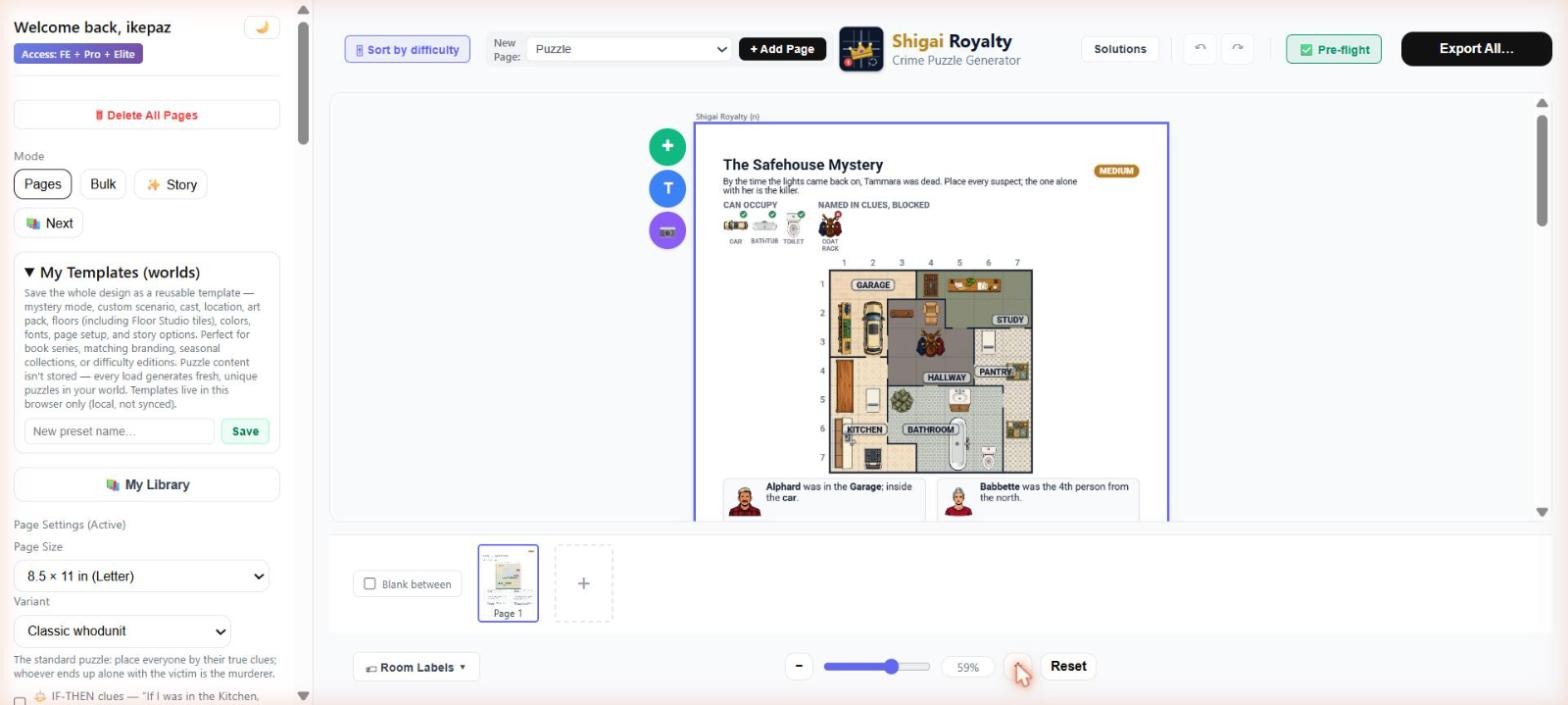
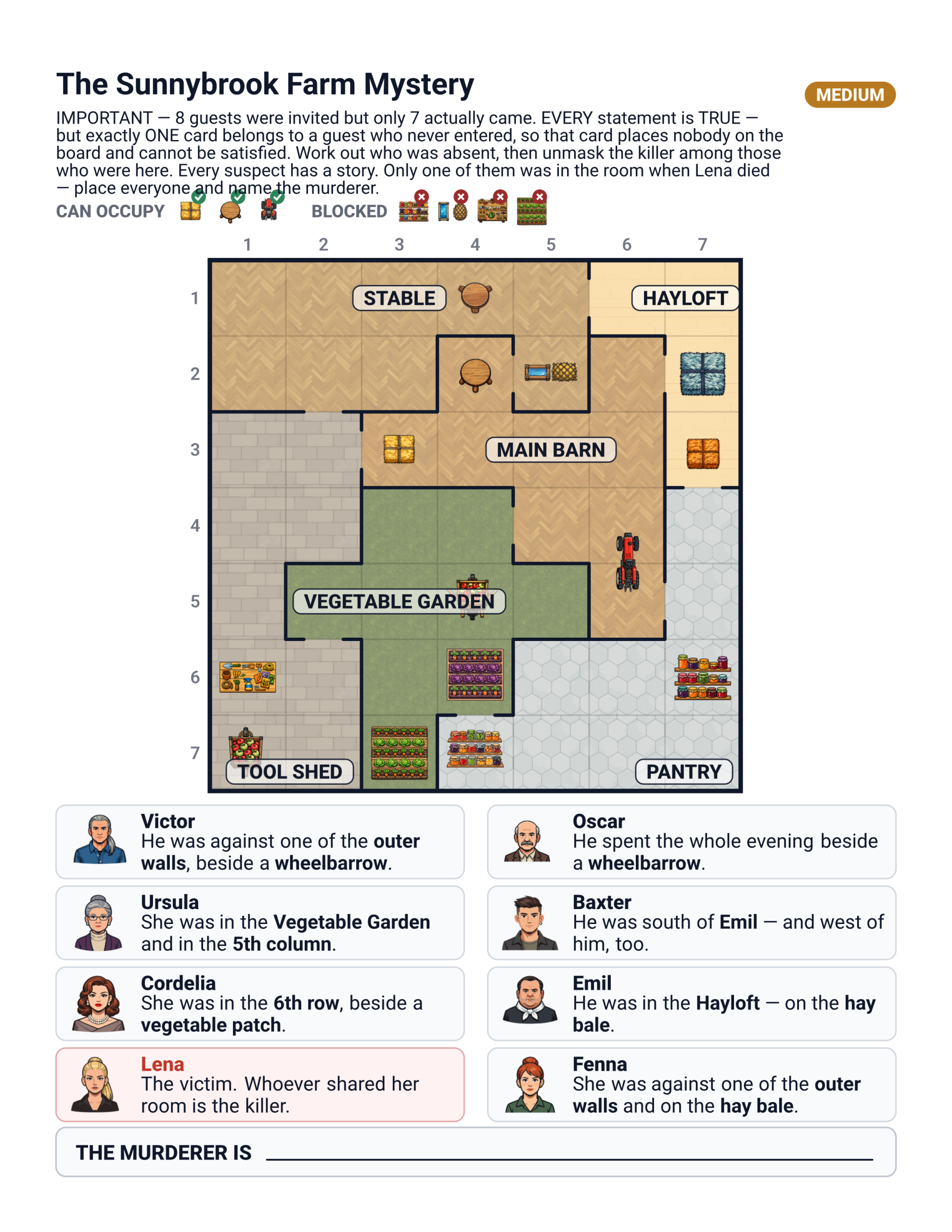
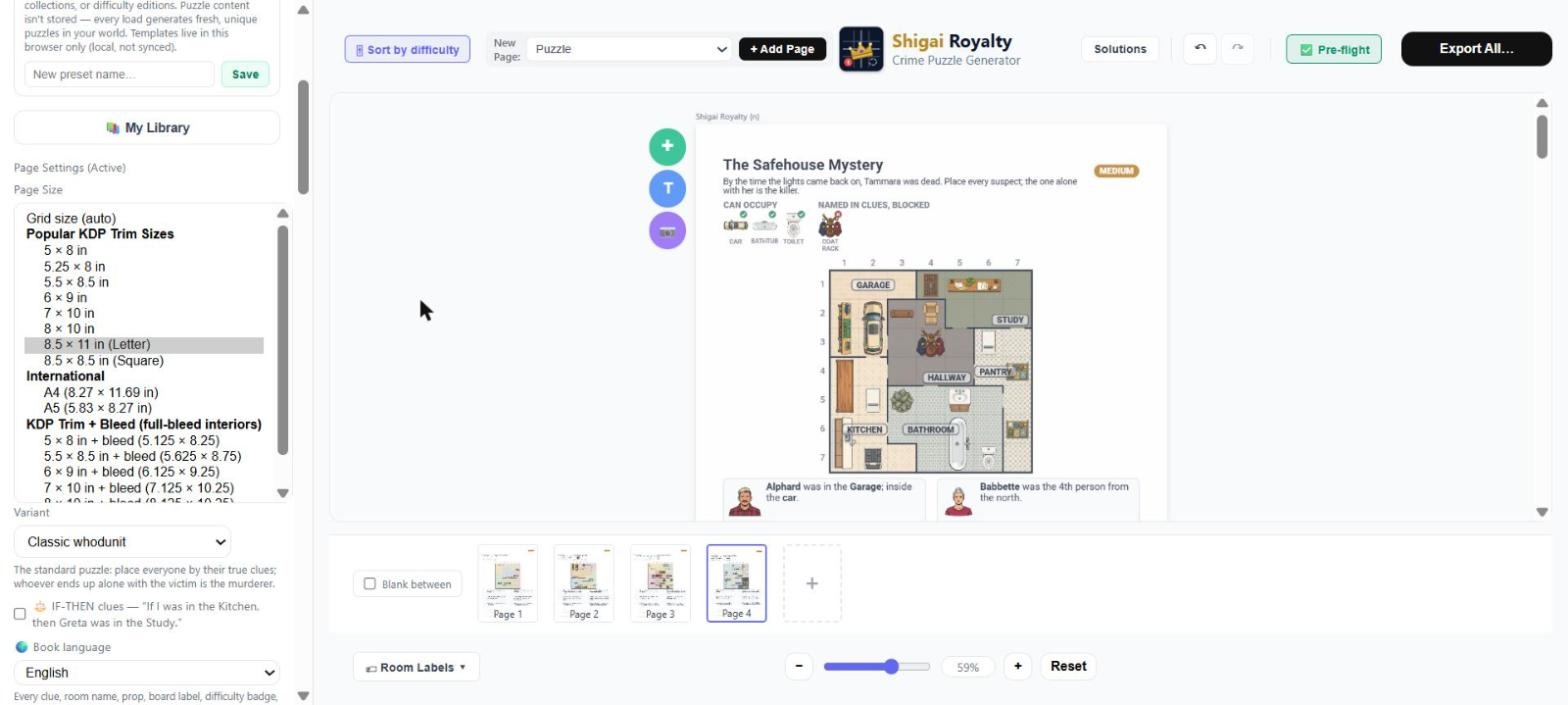
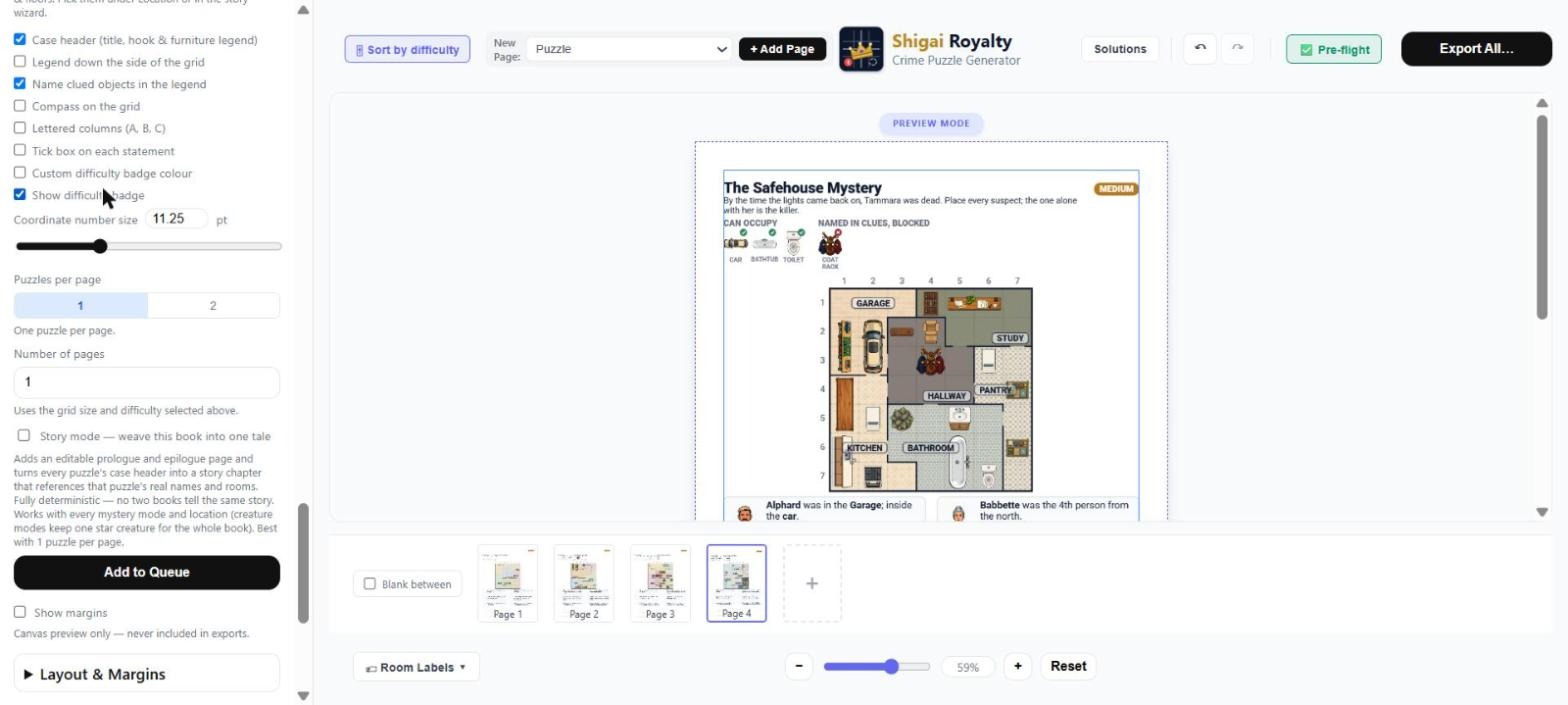
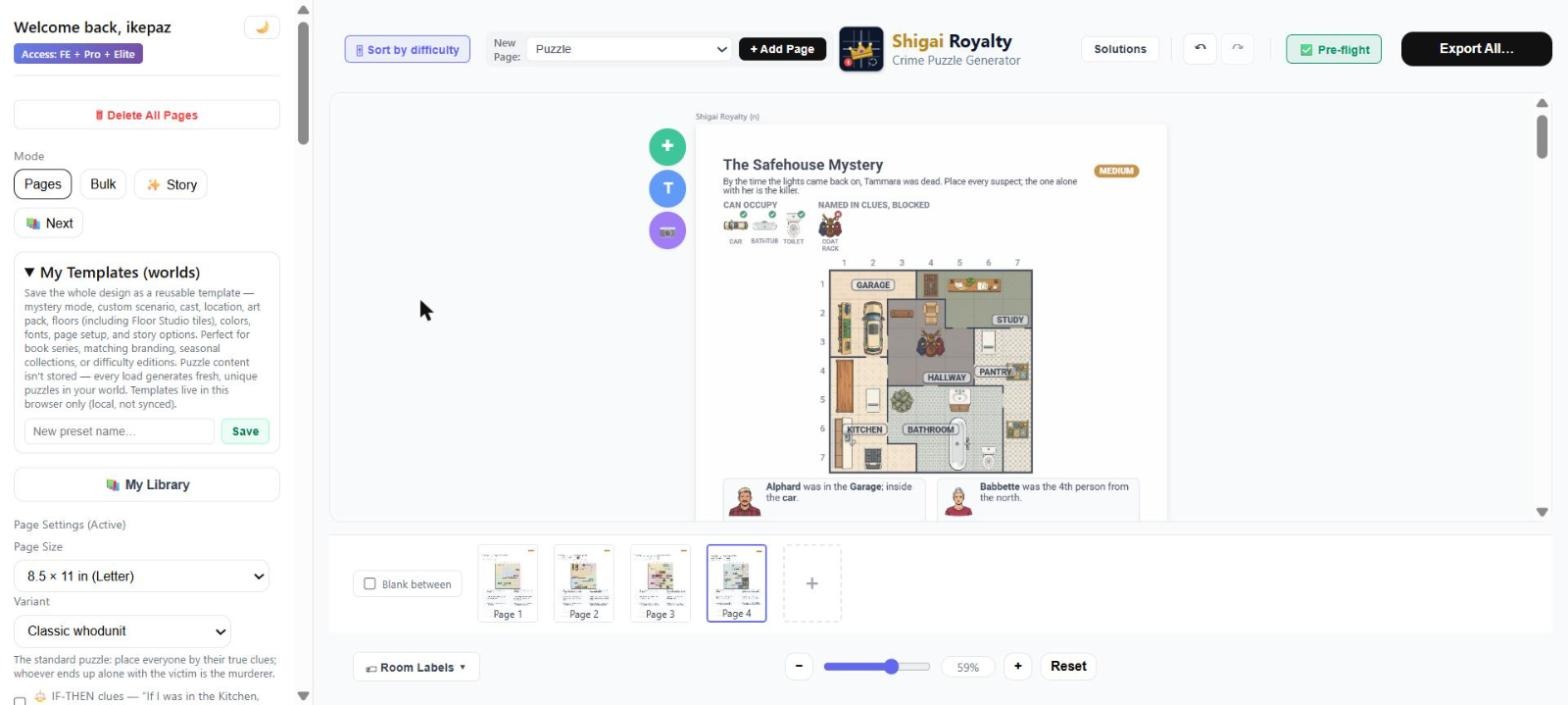
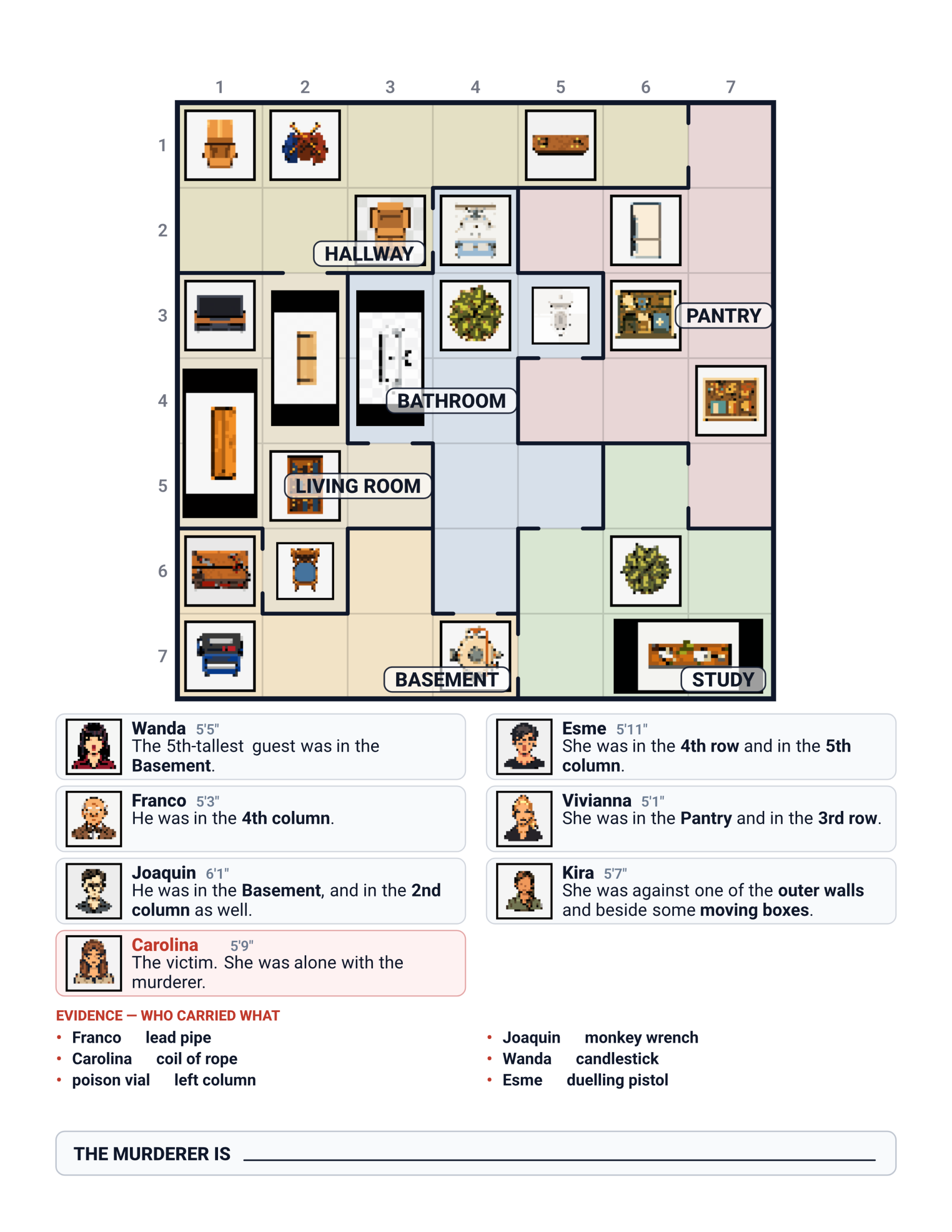
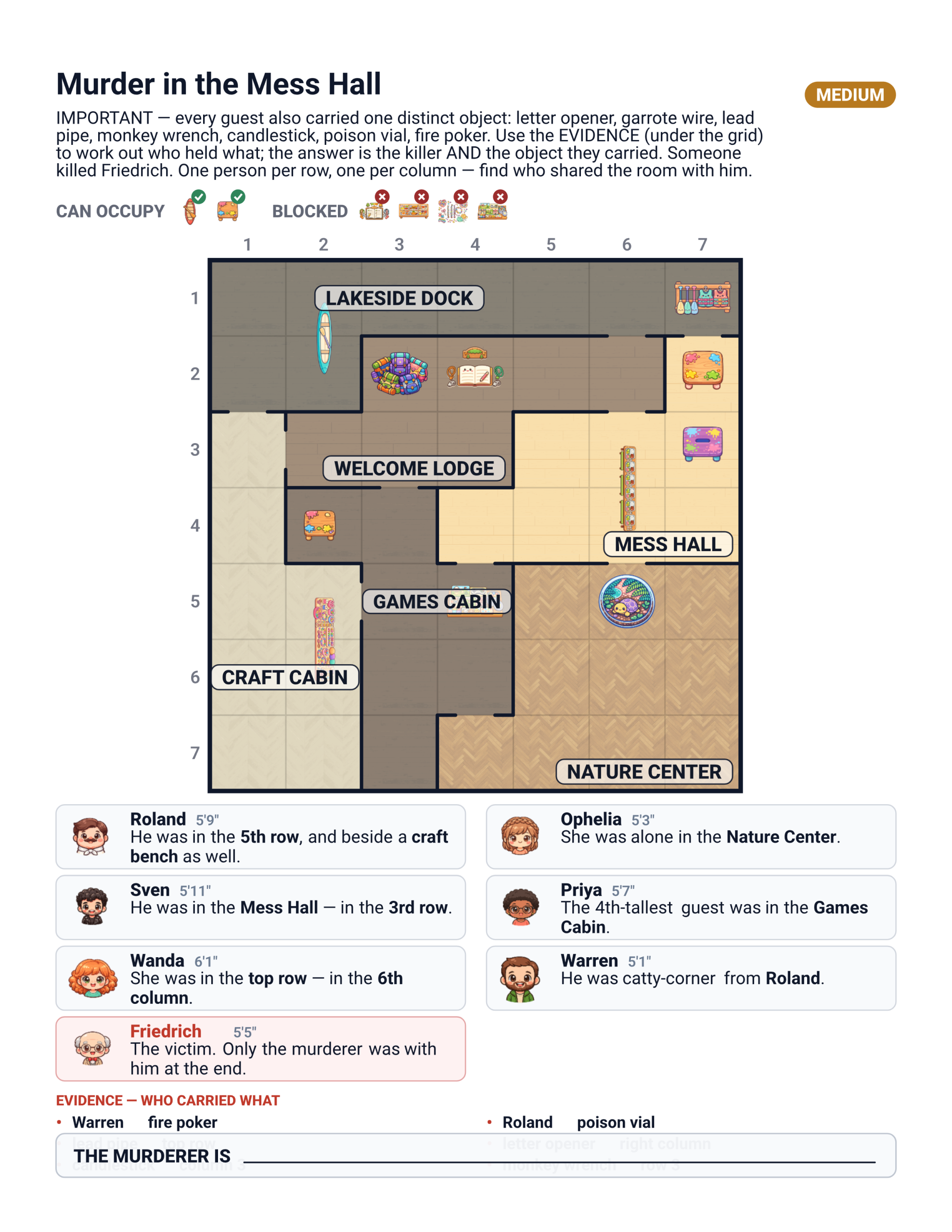
At $19, you're getting all five difficulty levels (Easy through "Dragon"), every grid size from 6×6 to 16×16, custom casts with photo upload, custom rooms, both the classic Murder Mystery and Heist modes, a hints ladder with step-by-step solution walkthroughs, the full KDP page designer with bulk generation, unlimited PNG exports, and 100 PDF exports a month.
To put that in perspective: 100 PDF exports a month is enough to build several full-length books, since a typical puzzle book might use somewhere between 20 and 60 individual case exports depending on length and how many bonus pages (hints, solution walkthroughs, a how-to-solve tutorial spread) you include per case. Unless you're planning to publish a genuinely high-volume catalog in your very first month, that cap isn't something most people will bump into right away.
What actually matters here is that nothing about the core puzzle-building experience feels handicapped. You're not stuck with one difficulty, one grid size, or a "sample" scenario. You get the same verified, single-solution deduction engine that the higher tiers are built on top of — the upgrades add variety and scale, not the basic ability to publish a real, sellable book.
Verdict: the front end alone is enough to build and publish a real book. Everything past this point is about scale and variety, not unlocking basic functionality.
File 02 — The Price Ladder
Four Tiers, One Combined Toolkit
Here's the full lineup at a glance before we open each file individually:
Genten Royalty is a separate math-mystery companion product, not a requirement for Shigai Royalty itself — more on that below.
Notice what's absent from this list: there's no recurring subscription tier, and there's no tier that requires you to already own a different tier just to function on its own. Each purchase stands alone. PRO doesn't require the front end to run, and ELITE doesn't require PRO — although in practice, most publishers work their way up naturally as their catalog grows, buying PRO once they've validated the front end works for them, and ELITE once they're ready to scale into multiple editions and seasonal releases.
That structure is worth calling out because a lot of software in this space uses a "ladder-locked" model, where you can't access tier three without first owning tier two, even if tier three is the only one you actually want. Shigai Royalty doesn't do that. You could, in theory, buy ELITE on day one if you already know you're planning a large catalog — though for most first-time publishers, starting at the front end and upgrading once you've actually published a book is the more sensible path.
File 03 — Upgrade 01
Shigai Royalty PRO
$57
Where you go once you're ready to publish more than a single book format.
- Lying Killer & One Wasn't There puzzle variants — new logic structures, not reskins
- Choose-the-culprit mode for personalized gift books
- All 9 kid & family modes, plus the Kawaii art pack
- Premium page design: borders, tints, dossier-style headers
- Self-check ciphers, printable certificates, custom fonts
- Floor Studio + custom furniture uploads
- Unlimited PDF and PPTX export (no monthly cap)
Worth it if: you're publishing more than one or two titles and want to lift the export cap while adding genuinely different puzzle mechanics — not just a cosmetic reskin.
File 04 — Upgrade 02
Shigai Royalty ELITE
$187
The tier built for a real, scaled-up catalog rather than a handful of titles.
- 5 premium variants, including Grand Mystery and Accomplices
- IF-THEN conditional clues and coded cipher clues
- 11 seasonal modes plus a custom scenario builder
- All 14 artwork packs, including the Elite Textured style
- Edition variants: Large Print / Pocket / B&W SKUs from the same case
- World Builder and the one-click Story Book wizard
- KDP pre-flight checks, front matter generation, Spanish (beta), SVG export
Worth it if: you're planning a real multi-SKU catalog — different editions, seasonal releases, or foreign-language variants — and want the software handling KDP pre-flight checks instead of you catching formatting errors after upload.
File 04.5 — Witness Statements
Who Each Tier Actually Fits
Rather than just listing features, it's worth walking through a few realistic publisher profiles and where each one lands on the pricing ladder. If you see yourself in one of these, that's probably your starting tier.
The First-Timer
Never published a puzzle book before, wants to test the category before committing more money.
Start with the Front End. You get the complete verified engine, both core modes, and a real KDP-ready export — everything you need to publish one solid title and see how the category performs before spending another dollar.
The Series Builder
Already published one or two books, wants to turn this into an actual small catalog.
PRO is the natural next step. The additional puzzle variants mean your second, third, and fourth books don't feel like the same puzzle in a different cover, and the removed export cap matters once you're producing books regularly instead of one at a time.
The Catalog Publisher
Running or planning a real multi-title catalog, possibly across seasonal releases or multiple formats.
ELITE earns its price here. Multi-edition exports (Large Print, Pocket, B&W) from a single generated case mean you're not manually rebuilding a book three times to hit three different reader segments, and the KDP pre-flight checks catch formatting issues before they become a rejected upload or a bad review.
The Educator-Minded Publisher
Interested in the homeschool, classroom, or tutoring market rather than general puzzle-book buyers.
Genten Royalty is the one to look at, separately from the core Shigai Royalty tiers. It's a different audience and a different puzzle mechanic (math-based rather than pure logic deduction), so it's worth treating as its own decision rather than an add-on to whichever Shigai Royalty tier you already own.
File 05 — Upgrade 03
Genten Royalty
$47
A separate but related studio — worth knowing about even though it's optional.
- Math Mystery studio: whodunits solved through math instead of pure logic clues
- Covers grades 1–6, with roughly 50 math-skill generators
- 163 themes, including 95 kid-safe worlds
- 5 case generators, including an Escape Adventure format
- 9 full book languages
- Every case verified sound by simulation, same core guarantee as the main engine
Worth it if: you want to branch into the education and homeschool market — teachers and parents are a genuinely different buyer than the general puzzle-book crowd, and this is a distinct product line rather than a Shigai Royalty feature.
File 05.5 — The Ledger
What It Actually Takes to Break Even
Numbers are more useful than adjectives here, so let's do a rough, conservative pass at breakeven math. This isn't a promise of results — actual sales depend heavily on your listing, keywords, cover, and how much effort you put into the publishing side — but it's a way to sanity-check whether the pricing makes sense relative to typical KDP royalties.
A paperback puzzle book on KDP commonly nets somewhere in the range of $2 to $5 in royalties per copy after printing costs, depending on page count, trim size, and list price. At even a conservative $3 per copy:
- The $19 Front End breaks even at roughly 7 copies sold — often achievable from a single book's first few weeks
- The $57 PRO tier breaks even at roughly 19 copies — realistic across two or three published titles
- The $187 ELITE tier breaks even at roughly 63 copies — meaningful once you're running a multi-title catalog rather than a single book
None of this accounts for printable-marketplace sales, which can add a second revenue stream from the exact same generated content, or for the possibility that a well-positioned title in an underserved category sells considerably better than the conservative $3-per-copy assumption. The point isn't to promise a number — it's to show that the pricing tiers scale roughly in line with what a realistic publishing effort could reasonably recover, rather than being priced arbitrarily high relative to the category's earning potential.
File 05.6 — Member Statements
What Actual Publishers Report
Testimonials are easy to cherry-pick, so take these as data points rather than guarantees — but a couple of the reported results are specific enough to be worth noting rather than dismissing outright.
One member reported publishing ten books since early July and selling 146 copies across that catalog — a result that lines up with the "build a series, not a single title" approach this software is designed around, rather than any single book carrying the whole result. Another member described three titles that consistently sell copies every month, which reflects the more realistic long-term goal for most publishers: a steady, repeatable catalog rather than one viral hit.
What both of these examples have in common is that neither result came from a single book — they came from a small catalog built over time. That's consistent with how KDP tends to work generally: individual titles are unpredictable, but a catalog of several related books in an underserved category tends to produce steadier, more predictable results than betting everything on one release.
File 06 — Side by Side
Which Tier Actually Fits You
| Tier | Price | Best for | Puzzle variants |
|---|
| Front End | $19 | Publishing your first verified mystery book | 2 modes |
| PRO | $57 | Running a small, varied catalog | 4 modes |
| ELITE | $187 | Scaling a multi-edition, multi-SKU catalog | 9 modes |
| Genten Royalty | $47 | Branching into the education/math niche | Separate product |
If you're only publishing your first book to test the waters, the $19 front end is genuinely not a stripped-down trial — it's a complete, publishable toolkit. PRO earns its price back quickly if you're publishing a series rather than a single title. ELITE only makes sense once you're thinking in terms of a catalog, not a book — the pre-flight checks and edition variants are catalog-management tools, not single-book features.
File 07 — Interrogation Room
Pricing Questions, Answered
- Do I have to buy every upgrade to use the software?
- No. The $19 front end is fully functional on its own — the upgrades add variants, art packs, and catalog-scale tooling, not core functionality.
- Is Genten Royalty required for Shigai Royalty to work?
- No — it's a separate math-mystery product for a different audience (education and homeschool buyers), not an add-on required by the core engine.
- What's the real difference between PRO and ELITE?
- PRO adds new puzzle mechanics and lifts your export limits. ELITE is built for scale — multiple editions from one case, seasonal releases, a scenario builder, and KDP pre-flight checks aimed at people managing a real catalog rather than a handful of books.
- Are there recurring fees on any tier?
- No — these are one-time purchases per tier, not subscriptions.
- Can I upgrade later instead of buying ELITE right away?
- Yes. There's no requirement to buy the highest tier up front — most publishers start at the front end, confirm the category works for them, and upgrade once they're actually producing enough books to need the extra scale features.
- Does a higher tier mean higher-quality puzzles?
- No — puzzle verification (the exactly-one-solution guarantee) is identical across every tier. Higher tiers add more scenario variety, more artwork packs, and more catalog-management tooling, not a "better" version of the core logic engine.
- What happens if I only ever need the front end?
- Nothing — there's no forced upgrade path or feature that stops working after a certain point. If the front end covers what you need, there's no requirement to buy anything further.
File 07.5 — Common Mistakes
Mistakes to Avoid When Choosing a Tier
Buying ELITE before publishing a single book. It's tempting to want every feature up front, but the multi-edition exports and pre-flight checks in ELITE solve catalog-scale problems you won't actually encounter until you have a catalog. Start smaller, confirm the category works for your audience, then scale up.
Assuming the front end is a stripped-down trial. Some publishers skip straight to PRO or ELITE assuming the $19 tier is a limited demo. It isn't — the core verified engine, both main modes, and a full KDP-ready export pipeline are all included at the entry price.
Treating Genten Royalty as a required add-on. Because it's from the same product family, it's easy to assume Genten Royalty is a necessary companion purchase. It isn't — it's a separate product for a different audience (math-based puzzles for the education market), and skipping it has no effect on how Shigai Royalty itself functions.
Ignoring the export caps until they matter. The front end's 100-PDF-per-month cap is generous for a first book, but if you're planning to publish several titles in your first month rather than spacing them out, it's worth checking whether PRO's unlimited export makes more sense from day one.
File 08 — Case Closed
Final Word on Pricing
The pricing structure here actually makes sense once you see what's behind each number. You're not paying $19 for a locked demo — you're paying for a real, publishable tool, and every upgrade past that point buys scale, variety, or a new market rather than gatekept basic features.
If you're weighing this against the "old way" of building a deduction puzzle book — days of manually plotting suspects and clue chains, then hoping your logic doesn't quietly allow for two possible killers — the front end alone already replaces that entire process for less than the cost of a single freelance puzzle commission. Everything above that price point is about how far you want to scale the catalog, not whether the core tool works.
My honest recommendation: start at the front end unless you already know you're publishing a large, multi-edition catalog from day one. Publish a book, see how the category performs for you, and let your actual results decide whether PRO or ELITE is worth the next step up — rather than guessing up front based on a sales page's badge placement.